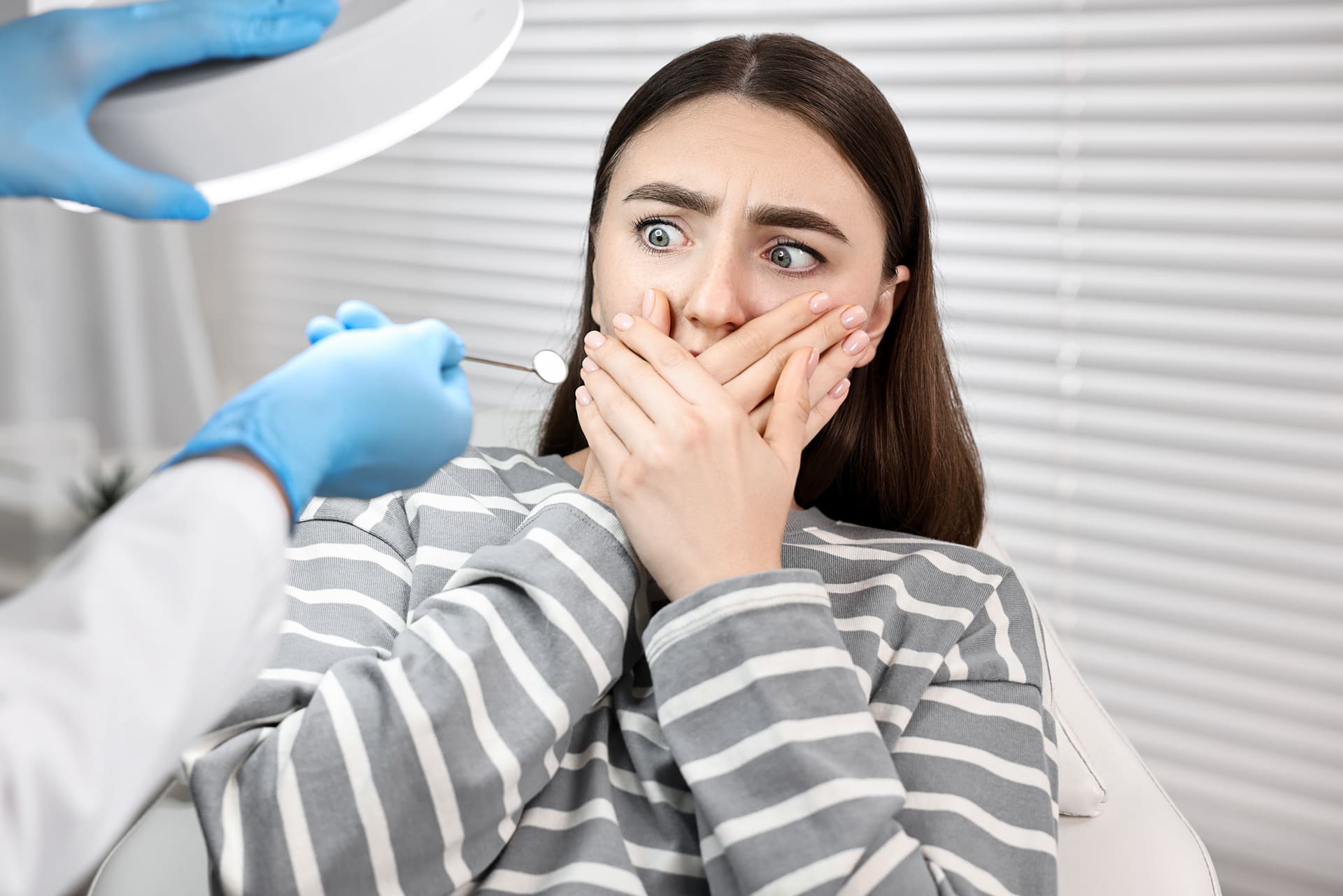
Fear of the dentist can appear at the very thought of booking an appointment. Some people feel uneasy because of the sound of dental instruments, others because of injections, the possibility of pain, or the feeling that they have no control during treatment.
For some patients, this is mild nervousness that fades once the examination begins. For others, the fear is so strong that they postpone dental visits for months or even years, even when they know there is a problem with a tooth.
Postponing treatment often reinforces the fear. A small problem that could have been solved with a simpler procedure may become more complicated over time, confirming the patient’s feeling that going to the dentist is something difficult and unpleasant.
The good news is that a dental visit does not have to begin with a major procedure. The first step can simply be a conversation, an examination, and an agreement about what makes you most uncomfortable. Modern dentistry allows for good pain control, an adjusted pace of treatment and, when medically appropriate, the use of conscious sedation.
In this guide, we explain why fear of the dentist develops, how it can be reduced gradually, what you can do before and during an appointment, and when additional methods such as conscious sedation may help.
What is fear of the dentist?
The terms fear of the dentist, dental anxiety and dental phobia are often used as if they mean the same thing, although in practice they may describe different levels of discomfort.
Mild dental anxiety can mean nervousness before an appointment, restless sleep the night before or an uncomfortable feeling when entering the dental office. Fear is often linked to a specific situation, such as an injection, pain, tooth extraction or the sound of dental instruments.
With very strong and persistent fear, a person may begin to avoid dental treatment altogether. In such cases, it is especially important to plan treatment gradually and individually, without creating additional pressure.
There is no single approach that suits everyone. A person who is afraid of needles does not necessarily need the same approach as someone who has had an unpleasant previous experience or a strong sense of losing control.
Why are we afraid of the dentist?
Previous unpleasant experience
One painful or unpleasant procedure can affect expectations of future appointments for a long time, especially if the patient did not understand what was happening or felt that they were not being listened to.
Fear of pain
Many patients expect pain before the procedure has even started. This can make them highly sensitive to pressure, vibrations and sounds that they interpret in advance as a sign that something will hurt.
Fear of injections
For some people, the main problem is not the dental procedure itself but the thought of a needle or the administration of local anaesthetic.
Feeling of losing control
Lying in the dental chair, keeping the mouth open and having limited communication during treatment can make some patients feel vulnerable.
Sounds, smells and instruments
The sound of the dental drill, characteristic smells in the clinic or the sight of instruments can trigger unpleasant memories and an automatic fear response.
Embarrassment about the condition of the teeth
Patients who have not had a check-up for a long time are sometimes less afraid of the procedure itself than of the dentist’s reaction. Embarrassment about tooth decay, missing teeth or the appearance of the smile can become another reason to postpone an appointment.
How can you identify what exactly frightens you?
Instead of the general statement “I am afraid of the dentist”, it is useful to identify as precisely as possible what triggers the fear. This allows the dentist to adjust communication, pace and the way treatment is carried out.
| What makes you uncomfortable? | How the fear may appear | What may help |
|---|---|---|
| Possibility of pain | Tension before treatment, expectation of pain | Discussion about anaesthesia and pain control |
| Injection | Postponing an appointment because of needles | Tell the dentist in advance and agree on the pace |
| Sound of instruments | Tension as soon as the instruments start | Breaks, explanation of the procedure, headphones when appropriate |
| Loss of control | Need for frequent interruptions | An agreed signal for a pause |
| Previous bad experience | Strong nervousness even before arriving | A slower first appointment and conversation |
| Condition of the teeth | Embarrassment and postponing the visit | A non-judgmental examination and treatment in stages |
| REMEMBER The better your dentist understands what you are afraid of, the easier it is to adapt the approach to you. |
|---|
How can you overcome fear of the dentist?
Fear is rarely resolved by one sentence or one appointment. The goal is not necessarily to reach a point where you never feel nervous again, but to prevent fear from stopping necessary treatment.
- Say that you are afraid when booking the appointment. There is no need to wait until you are already in the dental chair. When arranging the visit, you can say that you have a strong fear of the dentist and would like the dental team to know this beforehand.
- Agree on a signal for a pause. A simple signal, such as raising your hand, can increase the feeling of control. Agree that, when possible and safe, the procedure will briefly stop when you give that signal.
- You do not have to solve everything at the first appointment. If you have not visited a dentist for years, the first appointment can be an examination, a conversation and diagnostics. The next procedure is then no longer completely unknown.
- Agree on how much information you want. Some patients want to know every step before it happens, while detailed explanations make others more tense. Say what suits you better.
- Start with a simpler procedure when possible. A positive experience with a shorter examination or a simpler procedure can help build trust before more complex treatment.
- Discuss additional options. If fear remains very strong despite an adapted approach, the dentist can discuss additional options with you, including conscious sedation when appropriate.
A dentist without pain: what does that mean today?
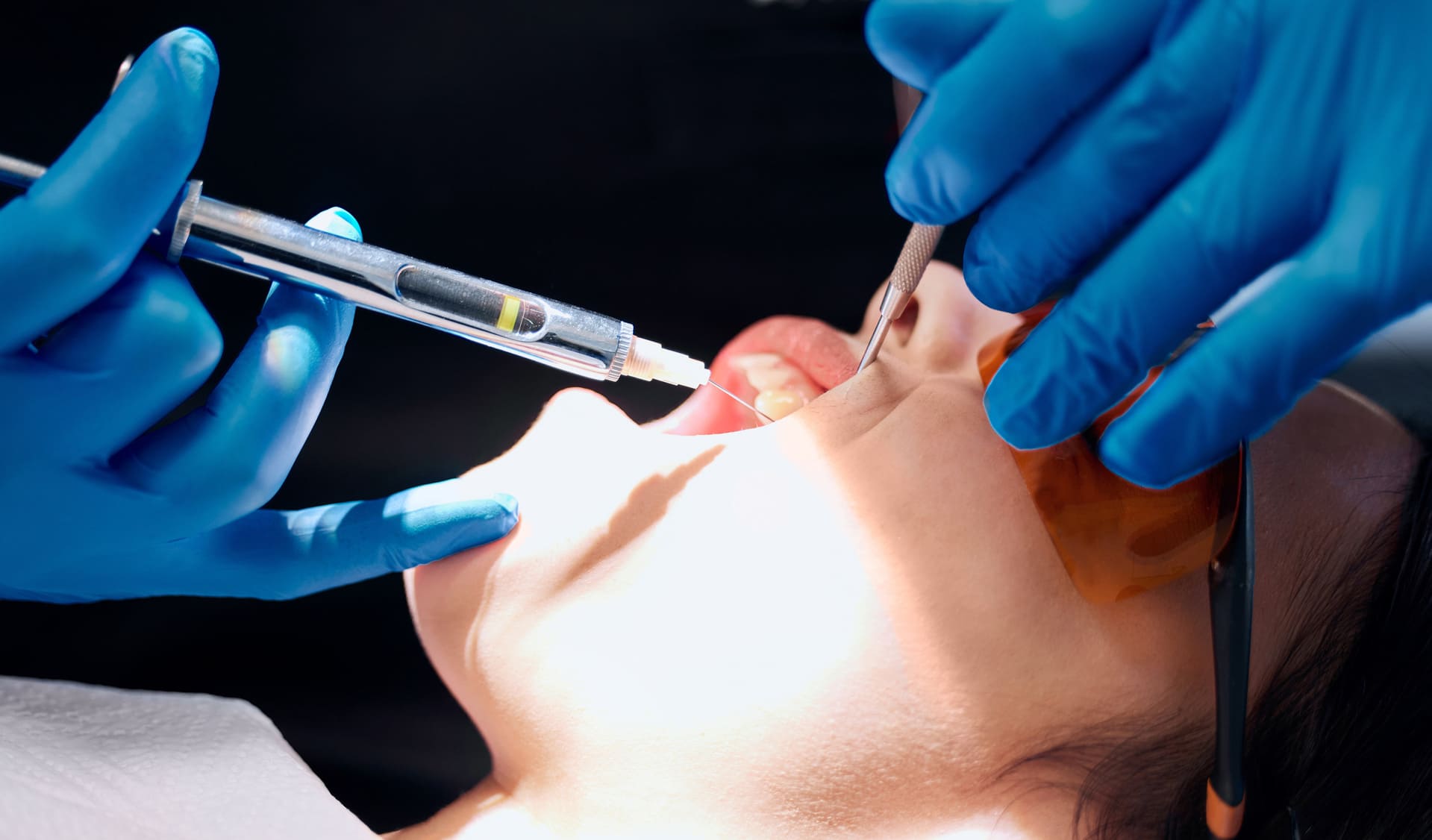
One of the main reasons for fear of the dentist is the expectation of pain. It is therefore important to distinguish pain control from fear control.
Local anaesthesia is used to make the area being treated insensitive to pain. Sedation, on the other hand, primarily reduces tension and anxiety. For procedures that would otherwise be painful, sedation does not replace appropriate local anaesthesia.
A patient who is afraid of pain therefore does not always need sedation. Sometimes the most important things are a clear explanation, proper administration of local anaesthetic and enough time for it to take effect. For other patients, the main problem is not pain itself but anticipation, panic or an inability to relax.
What is conscious sedation?
Conscious sedation is used to reduce fear, tension and anxiety during a dental or other medical procedure. It should not be confused with general anaesthesia.
The aim is for the patient to remain calm and relaxed while retaining the ability to respond and cooperate, depending on the type and depth of sedation used. The decision to use sedation is made individually after assessing the patient’s health, intensity of fear and planned procedure.
Read more about the options available at Dentico on the Conscious sedation page.
Is sedation safe?
The safety of sedation depends on proper patient assessment, the choice of an appropriate method, monitoring during the procedure and following instructions before and after treatment. Conscious sedation is therefore not something that is automatically performed on request without prior assessment.
Before sedation, it is important to tell the medical team about any illnesses, medicines you take, allergies, previous reactions to anaesthesia or sedation, and other relevant health information.
If there is a reason why a particular method is not suitable, the team will suggest another treatment approach or additional medical assessment.
What does sedation at the dentist look like?
The exact procedure depends on the sedation method, the patient’s health and the type of dental treatment. Before the procedure, the patient receives clear preparation instructions, and during the procedure their condition is monitored according to the medical protocol.
After treatment, some recovery time may be required. Depending on the method used, special instructions may apply regarding an accompanying person, driving, food, medicines and return to daily activities. It is important to follow the instructions of the team carrying out the procedure.
When can conscious sedation be an option?
| Situation | What to consider first | Next step |
|---|---|---|
| Mild nervousness before an appointment | Conversation, explanation, slower pace | An adapted approach is usually enough |
| Fear of injections or pain | Discussion about local anaesthesia and the treatment process | According to individual assessment |
| Severe anxiety that makes treatment difficult | Adapted approach and fear management | Sedation may be discussed |
| Years of postponing treatment because of fear | Examination and an individual plan | Additional assessment may be appropriate |
| Long or demanding procedure | Assessment of the procedure and the patient | Sedation may be considered |
| Complex health condition | Detailed medical history | Individual medical assessment is required |
Quick check: what makes going to the dentist most difficult for you?
| Check | My situation |
|---|---|
| ☐ | I postpone appointments even though I know I have a dental problem. |
| ☐ | I feel very nervous for days before the appointment. |
| ☐ | I am most afraid of pain. |
| ☐ | I am most afraid of injections. |
| ☐ | I dislike the feeling that I have no control during treatment. |
| ☐ | I have had an unpleasant previous experience. |
| ☐ | I feel embarrassed about the current condition of my teeth. |
| ☐ | Fear has previously prevented me from completing treatment. |
| RESULT If you selected several statements, tell the dental team when booking that you experience dental anxiety. The goal of the first appointment can be a conversation and a plan rather than immediate treatment. | |

How to prepare for your first appointment after a long break
If you have not visited a dentist for years, taking the first step may be the hardest part. Instead of thinking about the entire treatment plan, divide the process into smaller and clearer stages.
- Book only an examination. The first goal can simply be to come to the clinic, have an examination and find out the current situation.
- Mention your fear when booking. One sentence such as “I have quite a strong fear of the dentist and I have not had a check-up for a long time” gives the team important information.
- Write down what frightens you most. Before the appointment, think about whether you are mainly afraid of pain, injections, loss of control, the condition of your teeth or something else.
- Do not hide health information. Medicines, chronic illnesses, allergies and previous reactions to anaesthesia or sedation are important when planning treatment.
- Agree on a realistic plan. If several procedures are needed, treatment can often be organised in stages so that you know what comes next and why.
Myth or fact?
| Statement | Answer | Explanation |
|---|---|---|
| If I am afraid of the dentist, I must immediately ask for sedation. | MYTH | For many patients, communication, an adapted pace and good pain control are enough. |
| Local anaesthesia and sedation are not the same. | FACT | Anaesthesia controls pain in the treatment area, while sedation primarily reduces fear and tension. |
| I can agree on a pause before treatment starts. | FACT | An agreed signal can increase the feeling of control. |
| If I have not been to the dentist for a long time, I must have treatment immediately. | MYTH | The first appointment can be an examination, diagnostics and a discussion about the treatment plan. |
| Sedation is the same as general anaesthesia. | MYTH | Conscious sedation and general anaesthesia are different procedures. |
| It is important to list medicines and illnesses before sedation. | FACT | Medical history is an important part of assessment and safe planning. |
Fear of the dentist should not lead to long-term postponement
Avoiding a situation that causes fear can bring short-term relief, but it does not solve the problem for which an examination is needed. At the same time, it is unrealistic to expect every person to stop feeling nervous completely before seeing a dentist.
The goal can be simpler: book an appointment, say what you are afraid of, have an examination, understand what needs treatment and agree on an approach you can accept.
For some people, a conversation and a slower pace will be enough. Others may benefit from agreed breaks and effective local anaesthesia. In cases of pronounced fear, the dentist and medical team can assess whether there are indications for additional methods such as conscious sedation.
Frequently asked questions about fear of the dentist
Is fear of the dentist common?
Dental anxiety and different forms of fear related to dental treatment are not uncommon. The intensity can vary greatly, from mild discomfort to avoiding necessary treatment.
How can I overcome fear of the dentist?
The first step is to identify what specifically causes your fear and tell the dentist openly. Clear communication, agreed breaks, gradual exposure, pain control and individual treatment planning can all help.
What if I am mainly afraid of pain?
Say so before treatment. The dentist can explain which pain-control methods will be used and what you can expect. Local anaesthesia and reduction of dental anxiety are different but often connected parts of treatment.
Can I come just for a conversation and an examination the first time?
In many situations, yes. If there is no urgent condition requiring immediate treatment, the first appointment can be used for an examination, diagnostics and planning.
What if I am embarrassed about the condition of my teeth?
Postponing an appointment because of embarrassment often only prolongs the problem. The purpose of the examination is to assess the current situation and treatment options, not to judge the patient.
Is conscious sedation the same as general anaesthesia?
No. They are different procedures with different goals and levels of consciousness. The appropriate option is decided individually.
Will sedation remove pain?
Sedation and local anaesthesia have different roles. Sedation primarily reduces fear and tension, while local anaesthesia is used to control pain during appropriate dental procedures.
Is conscious sedation suitable for everyone?
No. Individual assessment is required based on health status, medicines, the type of procedure and other relevant factors.
What if my fear is so strong that I cannot come to the appointment?
When booking by phone or online, say that you have a very strong fear. The dental team can then suggest the first step and explain which approaches are available.
The first step can simply be a conversation
Fear of the dentist does not have to disappear before you book an appointment. It is often more important to find a dental team you can tell what makes you uncomfortable and with whom you can agree on a realistic pace of treatment.
If you have postponed a check-up for a long time because of fear or have a procedure that causes significant anxiety, book an appointment at Dentico Dental Centre. When booking, say that you are afraid of dental treatment.
Based on the examination, your health and the planned treatment, an approach can be agreed that suits you best and, when indicated, the option of conscious sedation can also be discussed.
| TAKE THE FIRST STEP WITHOUT PRESSURE Book an appointment at Dentico Dental Centre and tell us what makes you most uncomfortable about going to the dentist. |
|---|
The information in this article is for educational purposes and cannot replace an examination, diagnosis or individual advice from a dentist, doctor or other appropriate healthcare professional.